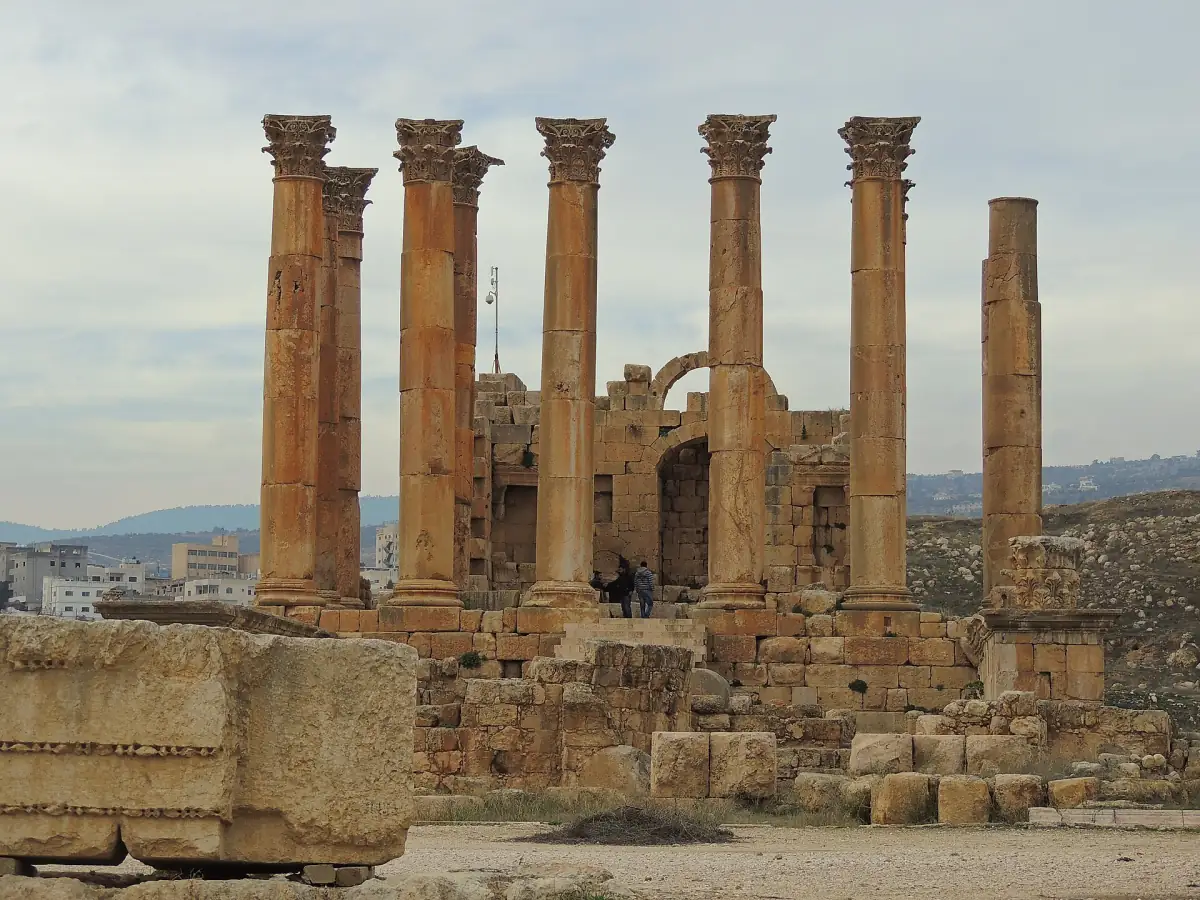
Jerash ruins and the history of Gerasa
The Jerash ruins preserve the Roman and Byzantine city of Gerasa in northern Jordan. Gerasa belonged to the Decapolis, the ancient grouping of cities, and its story extends beyond the standing colonnades. Human settlement reaches back to the Neolithic period; the visible temples and theatres belong to much later chapters. Reading the site as a changing city makes more sense than assigning every stone to one ancient moment.
Roman rule is associated with Pompey in 63 BC. Later, churches changed the religious landscape, followed by the Islamic conquest in 636 and prosperity under the Umayyads. The earthquake of 749 was a major disruption. Jerash is on the UNESCO Tentative List. For the practical side of seeing these remains, use the admission guide alongside this architectural overview.
Gerasa rewards attention to connections: the oval plaza leads into a colonnaded street, public buildings sit beside routes through the city, and later uses alter earlier sacred spaces. Decide whether those relationships are the focus of the day before adding other northern Jordan stops. The tour comparison separates a visit centred on Jerash from longer combinations.

Our take: a guided ruins visit
This outing pairs a professional ruins guide with entry and return transport from Amman.
Hand-picked tours, booked through GetYourGuide. Prices are indicative starting prices in US dollars (as of November 2026). Tap a tour for live availability and the current price in your currency.


Images – Jerash ruins with a professional guide: Cropped from a photo by Mohammad hajeer – CC BY-SA 4.0

A guided visit through Gerasa
The Jerash outing from Amman includes professional guiding through the ruins, site admission, return transport and lunch.
From Hadrian’s Arch to the Cardo and temples
Hadrian’s Arch at Jerash commemorates the emperor’s visit in AD 129/130 and provides a useful starting point for understanding imperial display. Its three openings frame a restored honorary monument. Our suggested sequence from arch to oval plaza, Cardo, temples and theatres is an editorial orientation, to be adapted to the visitor routes and barriers in place.
The oval plaza combines paving with Ionic columns and connects with the Cardo Maximus. Follow the idea of that colonnaded street toward the North Gate rather than thinking of the plaza as an isolated photo stop. The Nymphaeum beside the Cardo was a monumental public fountain; its historic decoration included marble below and painted stucco above. Ancient water architecture should be read as part of the city’s public life.
The Temple of Artemis at Jerash was dedicated to the city’s patron goddess, with construction beginning in the second century AD. Its later use by Umayyad potters adds another layer to the building’s history. The Temple of Zeus occupies higher ground near the oval plaza and South Theatre. Together these sanctuaries show how sacred buildings were placed within the wider urban landscape.
The South Theatre and the smaller North Theatre introduce another use of public space. Compare their setting with the street and temple areas without making the upper seating a required destination. A monument’s presence on a route is a reason to look and learn, while signs and barriers determine where visitors can actually go.
Byzantine churches and the archaeological museum
Jerash’s Byzantine churches extend the visit beyond Roman civic architecture. The monument commonly called the Cathedral is a fourth-century church built over remains of a temple of Dionysus, with reused elements from the sanctuary of Zeus. That reuse gives a concrete way to think about religious change without treating the later city as a separate destination.
The archaeological museum adds pottery, jewellery, coins, statues and mosaics to the buildings outside, with stone sarcophagi in its courtyard. Museum objects and city monuments offer different scales of evidence: one encourages close attention to materials and decoration, the other to streets and public spaces. Keep room for both rather than filling the whole visit with distant stops.
The Hippodrome as a historical building
The Jerash Hippodrome dates to the second century AD, with later reuse of its northern part for combat and other sporting events. Include the structure for its place in ancient entertainment. If a performance is important to the visit, obtain the programme for the actual travel date before arranging the day around a show.
Walking routes, shoes and onward planning
Jerash’s visitor routes should guide the walk through the ruins. Comfortable walking shoes, a hat, sunglasses and sunscreen are practical preparations. Plan transport with the Amman arrival guide, and use the season and weather guide to think about conditions rather than following a rigid monument timetable.
Questions about the Jerash ruins
What was Gerasa?
Gerasa was the ancient city now visited at Jerash, a member of the Decapolis. Its standing remains include Roman public architecture and Byzantine churches. Earlier settlement forms part of the wider history, so the age of human activity should be distinguished from the date of an individual monument.
What does the guided Jerash outing include?
The guided Jerash outing from Amman includes professional guiding throughout the ruins, archaeological site admission, return transportation and lunch at a local restaurant. The listed duration is one day. Choose this format when interpretation inside Gerasa matters alongside arranging the journey from Amman and back.
How should I approach the monument route?
The Jerash route can connect Hadrian’s Arch, the oval plaza, Cardo, temples and theatres as an orientation through the ancient city. Adapt that sequence to signs, barriers and conditions on the day. Leave time for the museum and churches rather than treating every monument as a timed checkpoint.